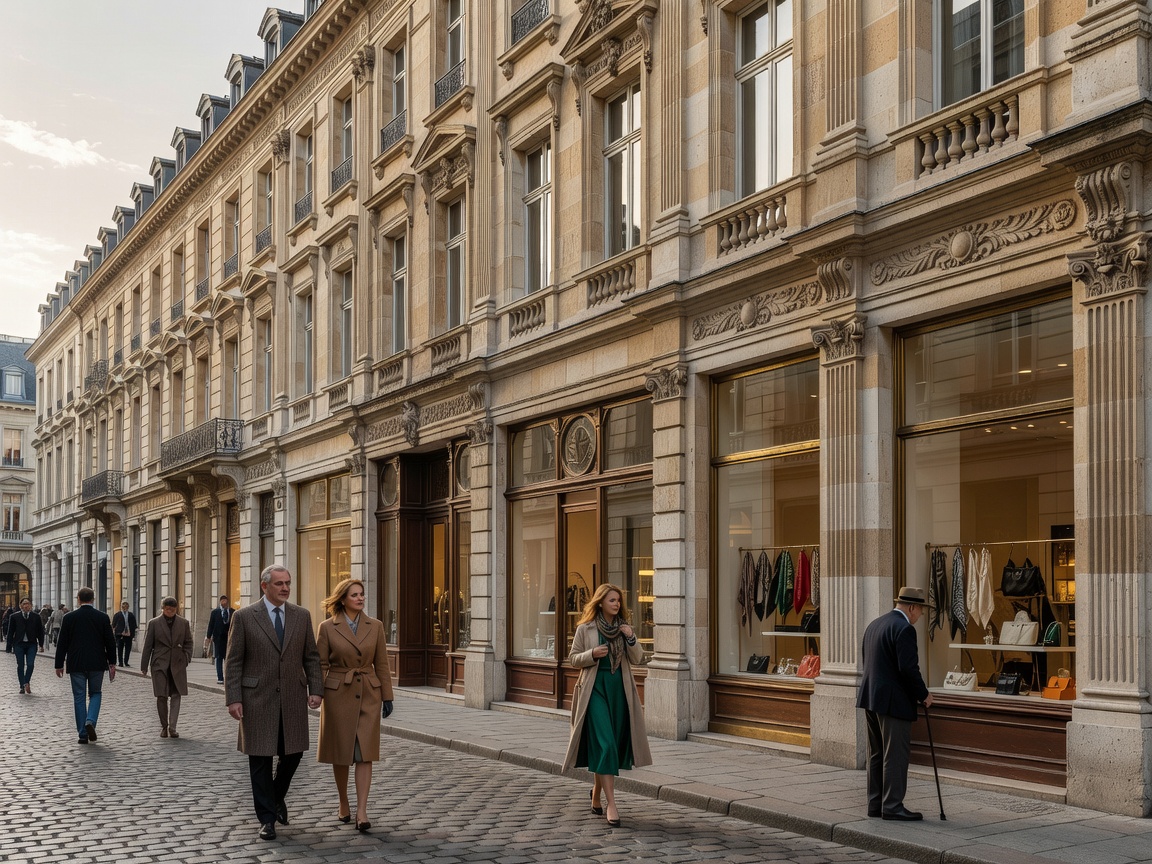
European shopping districts are varied urban environments: some are defined by several connected streets, others by department-store landmarks, historic passages or a concentration of contemporary retail. The most rewarding choice depends on what you want to see and how you like to move through a city—not on prestige alone.
What makes a district distinctive?
A luxury-shopping district generally has a recognisable retail identity, a walkable concentration of shops and an urban setting that gives the visit a sense of place. Its offer may include fashion, accessories, watches, home design and personal services, but the mix is never uniform. Streets may shift from high-profile storefronts to independent businesses, cafés, offices and cultural buildings within a short walk. Retail tenants and product ranges change over time, so treat a district description as context rather than a live directory.
Architecture matters. Broad avenues create long views and a formal pace; smaller streets invite slower browsing; covered passages provide shelter and a distinct interior experience. A destination can be visually impressive yet tiring to navigate if crossings, distance or crowding do not suit your plans.
Street districts and enclosed centres
Open streets connect directly to the city. They offer varied façades, public transport links and opportunities to combine browsing with a museum, square or café. Their trade-off is exposure to weather, traffic and uneven pavements. You will need to check the route and allow time between areas rather than assuming every shop is next door.
Enclosed centres and arcades gather retail under one roof. They can simplify wayfinding and offer shelter, seating and dining in a concentrated footprint. Their interiors can be architecturally compelling, but the visitor experiences a more managed environment and may see less of the surrounding neighbourhood. Department stores sit between these types: a single building can be a destination in its own right while remaining part of a larger street network.
Regional character, without easy stereotypes
Paris rewards attention to its distinct neighbourhoods and the links between grand boulevards, passages and smaller streets. Milan's central fashion area includes Via Montenapoleone and surrounding streets, but it is only one part of a city with a much wider design culture. In London, the Bond Street area belongs to a dense and varied West End, where walking routes also pass through streets with different retail and cultural identities.
Vienna's Goldenes Quartier area sits within a historic centre whose architecture and civic spaces are integral to the experience. Zurich offers a compact central environment where retail routes can be combined with the river and old-town streets. Madrid's central avenues and neighbourhoods present their own scale, climate and rhythm. None of these cities should be reduced to one shopping street, and their store mix, price range and visitor experience differ.
Plan around access and comfort
Start with a map or a trusted transit planner, then build a walk that makes sense geographically. Check step-free access, station lifts, pavement conditions and crossing distances using current local information; access varies by street and venue. Public transport is often more practical than trying to cover a large city centre entirely on foot. Leave a buffer for breaks, crowds, weather and the time it takes to browse.
Nearby cafés and hotels can make a route easier, but proximity alone does not guarantee the right fit. Compare transport connections, accessibility information, cancellation terms and amenities, and contact accommodation directly about luggage storage or other policies. Seasonal daylight, rain, heat and holiday schedules can change the feel of a day. Check current opening details with individual venues before setting out; we do not publish live hours or availability.
Compare the experience, not just the reputation
Consider three questions: how much walking suits you, what kind of architecture or retail setting interests you, and what else you hope to do nearby? A compact arcade may work well for a weather-sensitive visit; an open district suits travellers who want to read a city through its streets; a department store can make a focused stop. The answer may be a combination rather than a single “best” destination.
Good for
Travellers who enjoy design, urban history, window displays, walkable itineraries and mixing retail with cafés or cultural stops.
What to know
Tenant mixes, hours, product availability and access conditions change. Confirm details directly and plan a flexible route with rest stops.
Use this guide as a framework, then explore the street-level detail that makes a city your own.